
REVIEW · HANOI
Full-Day Hop On Hop Off Bus Tour in Hanoi
Book on Viator →Operated by ANH VIET HOP ON - HOP OFF VIET NAM · Bookable on Viator
Want a quick feel for Hanoi?
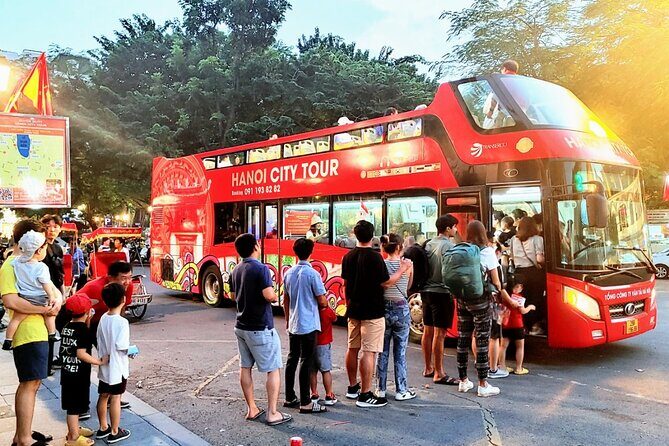
This full-day hop-on hop-off loop connects the big-name landmarks you actually want to see, with English audio and an AC bus that keeps you sane between stops. You pass everything from a French-era cathedral and opera house to iconic temples, war-era museums, and historic squares.
What I like most is the mix of famous sights with smart flexibility. I love that you can choose your own pace at key stops like St. Joseph Cathedral (no entrance fee) and One Pillar Pagoda (no entrance fee), instead of getting rushed through everything in a single sitting.
One thing to keep in mind: real traffic and route changes happen, and the bus experience isn’t always perfectly on-time. Plan a little buffer in your day, and expect that audio may not always match the exact moment you roll up to a stop.
In This Review
- Key things to know before you ride
- A full-day hop-on hop-off route that starts in the center
- How to use the hop-on hop-off format in Hanoi (without wasting time)
- Stop 1: Dong King Nghia Thuc Square (your day’s launchpad)
- Stop 2: St. Joseph Cathedral for a quick French-era snapshot
- Stop 3: Vietnam Military History Museum area and the Hanoi Flag Tower
- Stop 4: Ba Dinh Square and Ho Chi Minh’s Mausoleum
- Stop 5: One Pillar Pagoda for a small building with big symbolism
- Stop 6: Tran Quoc Pagoda, the oldest pagoda in Hanoi
- Stop 7: Yên Sở area and Cửa Bắc Church
- Stop 8: Quan Thanh Temple and Taoist symbolism
- Stop 9: Imperial Citadel of Thăng Long for the layers under Hanoi
- Stop 10: Temple of Literature (Văn Miếu) and Vietnam’s first national university
- Stop 11: Hoa Lò Prison, the Hanoi Hilton gatehouse
- Stop 12: Vietnamese Women’s Museum for social history that feels personal
- Stop 13: Hanoi Opera House, French architecture with star quality
- Stop 14: Hanoi Post Office by the lake (and the Henri Vildieu touch)
- Price and value: what you’re really paying for at $20
- What to pack and how to make the day feel easier
- Common snags to plan for (so your day stays fun)
- Should you book this Hanoi hop-on hop-off bus?
- FAQ
- What is the price of the Hanoi hop-on hop-off bus tour?
- How long is the tour?
- Is the tour available in English?
- Do I need to print anything?
- What’s included in the ticket?
- Are entrance fees included for all stops?
- Where do I meet the tour?
- How does the refill water work?
- Can I cancel for free?
Key things to know before you ride

- Meeting point is Dong King Nghia Thuc Square (No 7 Dinh Tien Hoang), which is handy for planning your day
- AC bus, WiFi, and onboard bottled water make heat and waiting less painful
- Conical hat and rain coat are included, a very practical bonus in Hanoi’s weather
- Some major sights have no entrance fee, including St. Joseph Cathedral and One Pillar Pagoda
- Several big attractions cost extra on-site, so budget some cash in VND
- Route and timing can shift, especially with traffic and public holidays
A full-day hop-on hop-off route that starts in the center

This tour is designed as a one-day, pick-your-own-adventure ride around Hanoi. It runs on an air-conditioned vehicle with WiFi on board, plus a city map to help you connect bus stops to what you see on the street. You also get a mobile ticket, and the operator supplies a pour of water (with paper cups) to cut down on plastic—just bring a reusable bottle so you can refill.
The practical starting point matters. Your meeting spot is at Dong King Nghia Thuc Square, No 7 Dinh Tien Hoang, near the ticket box area. From there, you can treat the bus like a moving base: ride to an area you want, hop off to explore, and hop back later when you’re ready.
Two small inclusions that feel bigger than they sound: the bus gives you conical hat and a rain coat. If you’re visiting in a wet season stretch, that can save your day from turning into a soggy walkathon.
You can also read our reviews of more tours and experiences in Hanoi
- Ninh Binh Full-Day Tour from Hanoi to Hoa Lu, Tam Coc & Mua Cave Via Boat & Bike
★ 5.0 · 4,384 reviews



How to use the hop-on hop-off format in Hanoi (without wasting time)

Hanoi is not a city where every sight is close to the next one. That’s why a hop-on hop-off loop is a solid first-day tool: you get transportation, orientation, and a rough sense of where the city’s major neighborhoods and landmarks sit.
Here’s how I recommend you use it:
- Start early so you catch sights before midday crowds.
- Plan your day in chunks. Do one “cluster” per ride segment, so you’re not constantly crossing the city.
- When you hop off, remember that some destinations may still require a short walk from the stop.
This style of tour also comes with an honest note: you may run into timing quirks. The operator warns that traffic, public holidays, weather, and other issues can change the schedule or route. In real life, that means it helps to build in slack—don’t schedule a timed reservation that can’t tolerate a delay.
Audio is part of the experience. I like that it’s offered in English, and the content is meant to give context as you move around. Still, audio doesn’t always perfectly match the exact spot outside your window, so use it as guidance, not as a GPS replacement.
Stop 1: Dong King Nghia Thuc Square (your day’s launchpad)
You begin at Dong King Nghia Thuc Square near No 7 Dinh Tien Hoang. This is where the bus ticket box is set up, so it’s also your anchor for the day’s timing.
Even though the tour is simple, I suggest you don’t treat the first ten minutes as guaranteed. Ticket verification can take time, especially if you booked through a third-party platform and the operator needs to confirm the booking details. If you want a smooth start, show up a bit early and keep your confirmation info ready on your phone.
Stop 2: St. Joseph Cathedral for a quick French-era snapshot
One of the best “starter” stops is St. Joseph Cathedral, built in the late 1800s by French colonial authorities. It opened in December 1886, and it’s described as having an architectural style similar to Notre Dame de Paris. It’s also the oldest church in Hanoi, and the good news for your wallet is it has no entrance fee.
Practical tip: this is a great place to pause for photos, but also a chance to understand the French colonial footprint in the city center. From here, you can build your day around big landmarks that feel visually distinct—church facades, civic squares, and historic institutions.
Stop 3: Vietnam Military History Museum area and the Hanoi Flag Tower
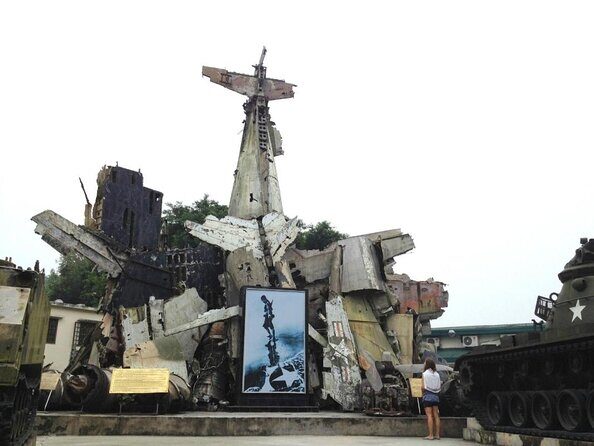
The stop labeled around the Vietnam Military History Museum connects with the Flag Tower of Hanoi, a symbol tied to the Hanoi Citadel. The key detail here is survival: the tower is one of the rare architectural works that wasn’t destroyed in the French administration period between 1894 and 1897. It’s now recognized as one of Hanoi’s historic symbols.
What you’ll get from this stop: a reminder that Hanoi’s history isn’t only temples and old streets. It includes fortifications and political eras that shaped modern Vietnam.
If you’re short on time, treat this stop like a quick historical check-in—see the tower area, grab your bearings, and move on. The value is in context: it helps the later museum and prison stops make more sense.






Stop 4: Ba Dinh Square and Ho Chi Minh’s Mausoleum

This stop sits at the center of Ba Dinh Square, where Ho Chi Minh’s Mausoleum is located. It’s the resting place of Vietnam’s revolutionary leader and president, Ho Chi Minh, and the building is tied to a specific moment in history: Ho read the Declaration of Independence on 2 September 1945, establishing the Democratic Republic of Vietnam.
Two important things for planning:
- The entrance fee is not included.
- You’ll want to budget extra time if you’re going for a deeper visit rather than just passing through the area.
Even if you’re not a museum-type person, this stop gives weight to Hanoi’s national story. It’s one of the most central places in the city for understanding how modern Vietnam frames its political identity.
Stop 5: One Pillar Pagoda for a small building with big symbolism
Next up is One Pillar Pagoda, famous for its special structure: a building laid on one pillar. The original pagoda dates to 1049, with additions and refinements around 1105. It’s considered one of Vietnam’s two most iconic temples (the other mentioned is Perfume Temple).
This one is also no entrance fee, which makes it a very high-value stop in a hop-on hop-off day. The experience is compact, and it’s easier to fit into a busy schedule than many larger temple complexes.
If you want a smooth visit, go with a quick goal: see the one-pillar structure, notice the layout, and take a short walk around the area for atmosphere. This is a “short stop, strong impression” kind of place.
Stop 6: Tran Quoc Pagoda, the oldest pagoda in Hanoi
Tran Quoc Pagoda is described as the oldest pagoda in Hanoi, originally constructed in the sixth century, during Emperor Ly Nam De’s reign (544 to 548). That puts it at more than 1,500 years old—the kind of age that changes how you look at simple details like stone and layout.
This stop is ideal if you want a calm contrast to the busy civic areas. Pagodas give you a different tempo: less of the “grid-and-traffic” feeling and more of the “pause and look” mood.
Stop 7: Yên Sở area and Cửa Bắc Church
This is where the tour description ties the Yên Sở area stop to Cửa Bắc Church. The church is a Roman Catholic church in Hanoi, built in 1932 by the French administration of Indochina. It was part of the city plan supervised by Ernest Hébrard.
Today, Cửa Bắc Church is described as one of Hanoi’s three major churches, alongside Ham Long Church and Saint Joseph Cathedral. If you did St. Joseph Cathedral earlier, this is a neat follow-up: same broader religious footprint, different building character.
Stop 8: Quan Thanh Temple and Taoist symbolism
Quan Thanh Temple is dedicated to Trần Vũ, deity of the North in Taoism. The description also points to the symbols tied to power in that belief system: serpent and turtle. It’s one of the Four Sacred Temples, built in four directions to protect the capital from malevolent spirits.
This stop is valuable when you want to see how Vietnamese spiritual traditions mix with city planning and cosmology. It isn’t just a building—it’s tied to the idea of guarding and balance in the urban space.
Practical note: the entrance fee is not included (listed as 10,000 VND). If you want to go inside, plan your cash accordingly.
Stop 9: Imperial Citadel of Thăng Long for the layers under Hanoi
The Imperial Citadel of Thăng Long is a major historical anchor. It was built in the 11th century by the Ly Viet Dynasty, marking the independence of Đại Việt. The citadel was built on the remains of a Chinese fortress from the 7th century, on reclaimed land from the Red River Delta after drainage.
This is a stop that helps you understand why Hanoi feels like it has “new life on old foundations.” The tour framing makes the point: the city you walk through now sits on earlier political and defensive structures.
The entrance fee is not included (listed as 30,000 VND). If your budget is tight, you can still appreciate the area from outside, but the full value comes from going in.
Stop 10: Temple of Literature (Văn Miếu) and Vietnam’s first national university
The Temple of Literature, or Văn Miếu, is dedicated to Confucius and also hosts the Imperial Academy, which is described as Vietnam’s first national university. The temple was built in 1070, during Emperor Lý Thánh Tông’s reign.
If you like sites that connect culture to education, this is one of the best stops on the route. It’s not just “a pretty courtyard”—it’s about how Vietnamese society organized learning and prestige.
Entrance fee is not included (listed as 30,000 VND). Factor that in if you’re doing several paid stops back-to-back.
Stop 11: Hoa Lò Prison, the Hanoi Hilton gatehouse
Hoa Lò Prison has a complicated story. It was used by French colonists for political prisoners and later by North Vietnam for U.S. POWs during the Vietnam War—where it became known to American POWs as the Hanoi Hilton.
The description notes that the prison was demolished during the 1990s, but the gatehouse remains as a museum. That makes this stop a focused, manageable visit rather than a massive ruin you need a whole day for.
Entrance fee is not included (listed as 30,000 VND). I suggest you treat it like a reflective stop: read the key signs, then step out and let the emotions settle before moving on.
Stop 12: Vietnamese Women’s Museum for social history that feels personal
The Vietnamese Women’s Museum opened to the public in 1995 and is operated by the Vietnam Women’s Union. The museum has a collection of more than 40,000 materials and artifacts, with permanent exhibits and special thematic shows using a social anthropology approach.
The description also emphasizes how exhibits target changes in society, especially projects focusing on vulnerable women and disadvantaged children. This is the kind of museum stop that can change your understanding of daily life, not just big politics.
Entrance fee is not included (listed as 40,000 VND). If you skip it, you’ll still get a strong mix from other stops—but this one adds a human lens that many history-only routes miss.
Stop 13: Hanoi Opera House, French architecture with star quality
The Hanoi Opera House (also called the Grand Opera House) was built by the French colonial administration between 1901 and 1911. It’s also one of three opera houses the French built in Indochina—along with Hải Phòng Opera House and the Municipal Theatre in Ho Chi Minh City.
This is an easy win if you like architecture. Even if you don’t go inside, the building sits in a classic central-city French style that feels like a different time period set down in Hanoi.
Entrance fee for this stop isn’t listed in your data, so for your planning, treat it as a look-and-photo stop unless you find an option on-site.
Stop 14: Hanoi Post Office by the lake (and the Henri Vildieu touch)
The last stop is the Hanoi Post Office, tied to the nickname post office by the lake. It’s described as more than 100 years old, with neoclassical architecture. The post office was designed and built by Henri Vildieu from 1894 to 1899.
This stop is more than a building. It’s where you can slow down and take in one of the most recognized civic landmarks from the French era in the city center.
Price and value: what you’re really paying for at $20
At $20 per person, this tour is priced like a smart transportation tool plus a guided overview of major areas. The key value is that you’re not paying just for sights—you’re paying for the day’s logistics: AC bus, WiFi, mobile ticket, city map, insurance, and included water and rain gear.
Where costs can quietly rise is entrance fees. Some big sites are not included, with listed fees like:
- Flag Tower area: 30,000 VND
- Ho Chi Minh Mausoleum: 25,000 VND
- Quan Thanh Temple: 10,000 VND
- Imperial Citadel of Thăng Long: 30,000 VND
- Temple of Literature: 30,000 VND
- Hoa Lò Prison: 30,000 VND
- Vietnamese Women’s Museum: 40,000 VND
- Tran Quoc Pagoda: 5,000 VND
Meanwhile, two stops that help your budget are St. Joseph Cathedral and One Pillar Pagoda, both described as no entrance fee.
My take on value: if you want to cover a wide set of iconic stops in one day without researching bus routes and transfers, $20 feels fair. If you plan to only do a couple of paid sites, the ticket still makes sense because it handles transport and orientation. If you hate extra entry charges, you’ll want to pick your paid stops carefully.
What to pack and how to make the day feel easier
A hop-on hop-off day can turn into a lot of walking if you’re not strategic. Here’s what I’d do based on what’s included and what can be unpredictable:
- Bring a reusable bottle. The operator provides refill water and paper cups, but your own bottle keeps it practical.
- Use the conical hat and rain coat, even if the forecast looks mild.
- Keep some cash in VND for the paid entrances. The listed fees add up if you decide to go inside multiple places.
- Plan to start at the center meeting point and do your farthest or most time-sensitive stops earlier.
Also, check the weather. The tour notes it requires good weather. If it’s canceled due to poor weather, you’ll be offered a different date or a full refund.
Common snags to plan for (so your day stays fun)
Let’s be honest: bus tours run in the real world, not in brochures.
Here are the issues that can pop up, based on past experience with this kind of service:
- Ticket verification can take time at the ticket office, especially when bookings need careful checking.
- Stops can be missed if you’re not perfectly in position, and if a bus signals and moves on, it can be frustrating.
- Buses and audio quality can vary. One common complaint in feedback is audio not matching location, and occasional equipment problems.
- Timing can slip. Waiting longer than expected for a bus can happen when the city gets congested.
So, I recommend this mindset: treat it as flexible sightseeing transportation. If something goes wrong, don’t let it snowball into a bad mood—shift your plan, pick the next bus opportunity, and keep moving.
Should you book this Hanoi hop-on hop-off bus?
You should book if you want:
- an easy first-day overview of Hanoi’s major landmarks,
- an air-conditioned way to move between distant sights,
- and a route that mixes paid museums with a couple of big no-fee stops.
Skip it (or at least manage expectations) if:
- you’re strict about perfect timing,
- you hate any chance of route or schedule shifts,
- or you plan to rely on audio as a pinpoint guide rather than general context.
For most people, this is a strong starting tool—especially if Hanoi is new to you and you want the city’s main pillars lined up in one day without overthinking transit.
FAQ
What is the price of the Hanoi hop-on hop-off bus tour?
The price is $20.00 per person.
How long is the tour?
It’s listed as 1 day (approx.).
Is the tour available in English?
Yes. The tour is offered in English.
Do I need to print anything?
No. The tour uses a mobile ticket.
What’s included in the ticket?
Included items are an air-conditioned vehicle, WiFi on board, all fees and taxes, conical hat and rain coat, insurance for passengers on the bus, a city map, and bottled water. The operator also supplies refill water with paper cups.
Are entrance fees included for all stops?
No. Some entrance fees are not included. Examples listed include Ho Chi Minh Mausoleum, Hoa Lò Prison, Thăng Long Imperial Citadel, Temple of Literature, the Vietnamese Women’s Museum, Quan Thanh Temple, and Tran Quoc Pagoda. St. Joseph Cathedral and One Pillar Pagoda are listed as no entrance fee.
Where do I meet the tour?
The meeting point and ticket box are at Dong King Nghia Thuc Square – No 7 Dinh Tien Hoang.
How does the refill water work?
The operator supplies a 20-liter water container to help reduce plastic waste. You should bring your own reusable bottle to refill. Paper cups are provided.
Can I cancel for free?
Yes. You can cancel up to 24 hours in advance for a full refund, and you can choose a different date or get a full refund if the tour is canceled due to poor weather.




More Full-Day in Hanoi
- Ninh Binh Full-Day Tour from Hanoi to Hoa Lu, Tam Coc & Mua Cave Via Boat & Bike
★ 5.0 · 4,384 reviews



More Tours in Hanoi
- Ninh Binh Full-Day Tour from Hanoi to Hoa Lu, Tam Coc & Mua Cave Via Boat & Bike
★ 5.0 · 4,384 reviews